> For the complete documentation index, see [llms.txt](https://help.boomerang3.com/llms.txt). Markdown versions of documentation pages are available by appending `.md` to page URLs; this page is available as [Markdown](https://help.boomerang3.com/boomerang-3-user-manual/dashboard/control_points.md).
# Control point handling
How control points appear, expire, and are signed.
Control points remind users about recurring tasks.
An administrator configures each control point with:
* title and description
* first due date/time
* repeat period
* optional end date
### Control points on the Dashboard
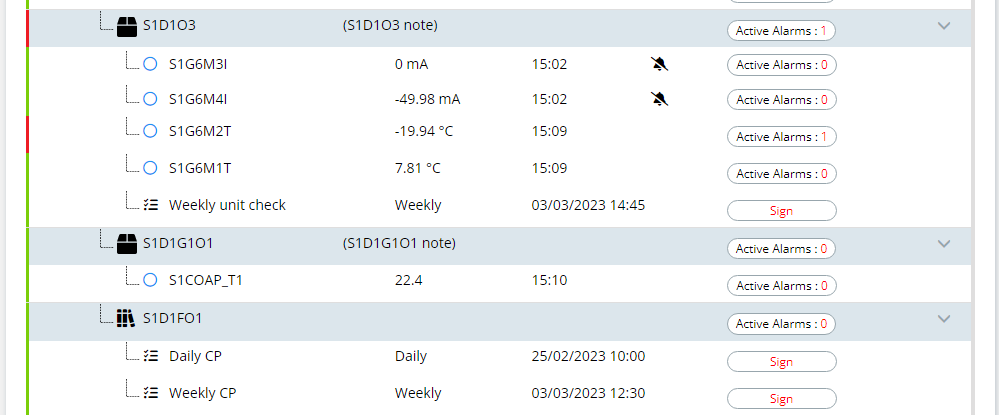
When a control point becomes due, it appears on the Dashboard.
It shows a frequency label (for example, **Weekly**) and a due time.
Active control points on the Dashboard
### Key terms
* **Expiration time**: the next deadline calculated from the start time and repeat period.
* **Active**: the control point is currently due and visible.
* **Signed**: a user has confirmed the task is done.
### Lifecycle
{% stepper %}
{% step %}
### Not active (already signed)
If the control point was signed before its expiration time, it is not active.
It is not shown on the Dashboard.
{% endstep %}
{% step %}
### Becomes active (due)
When the expiration time is reached, the control point becomes active.
It appears on the Dashboard.
The next expiration time is shown as the new deadline.
{% endstep %}
{% step %}
### Sign the control point
After completing the task, sign the control point.
* Click the **Sign** action to open the signing form.
* Add an optional comment.
* Sign the action.
Sign a control point
Signing is recorded in the logbook as **Control Point Signed**.
See [Logbook tab](/boomerang-3-user-manual/dashboard/object_view/detailed-object-view/logbook-tab.md).
{% endstep %}
{% step %}
### Accumulate expired checks (optional)
If **Accumulate expired checks** is enabled and a control point is overdue, the UI shows the number of expired checks.
Expired checks counter
Click the button to sign the expired checks.
{% endstep %}
{% step %}
### Automatic expiry signing
If a control point is not signed before its expiration time, the system signs it automatically.
The logbook records **Control Point Expired**.
After automatic signing, the control point can immediately appear again with the next expiration time.
Control point after automatic expiry
{% endstep %}
{% endstepper %}
### Control points in the object view
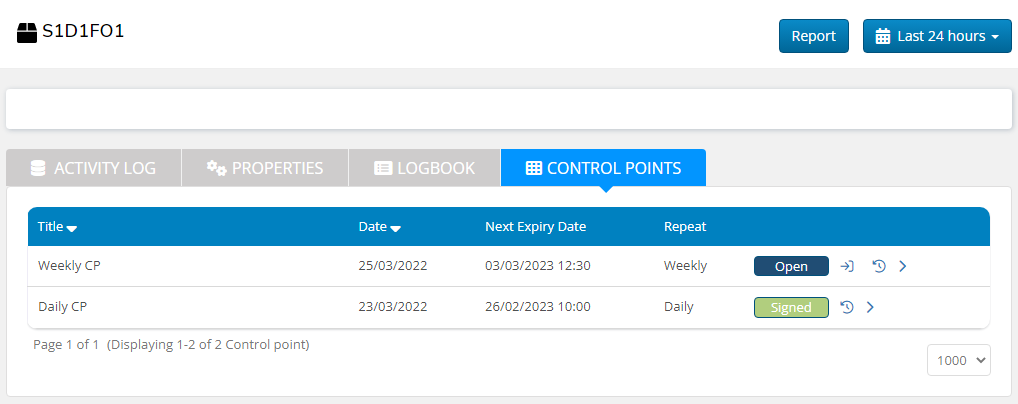
Open an object and select the **Control points** tab.
Control points tab
Control point open
Control point signed
* **Open / Signed** shows the control point state.
* Use the **Sign**  icon to sign.
* Use **History**  to see past signings.
* Use **Details**  to see configuration and description.
See also: [Control points tab](/boomerang-3-user-manual/dashboard/object_view/detailed-object-view/control-points-tab.md).
---
# Agent Instructions
This documentation is published with GitBook. GitBook is the documentation platform designed so that both humans and AI agents can read, navigate, and reason over technical content effectively. Learn more at gitbook.com.
## Querying This Documentation
If you need additional information that is not directly available in this page, you can query the documentation by asking a question.
Perform an HTTP GET request on the following URL with the `ask` and `goal` query parameters:
```
GET https://help.boomerang3.com/boomerang-3-user-manual/dashboard/control_points.md?ask=&goal=
```
`ask` is the immediate question: it should be specific, self-contained, and written in natural language.
`goal` is what the user is ultimately trying to achieve, the reason they need the answer. Sharing it helps GitBook give you a better, more relevant answer. A goal is most helpful when it describes the outcome the user wants rather than restating the question. For example, with `ask=how do I create an API token`, a goal like `automate deployments from our CI pipeline` lets GitBook tailor the answer to that use case.
The response will contain a direct answer to the question and relevant excerpts and sources from the documentation.
Use this mechanism when the answer is not explicitly present in the current page, you need clarification or additional context, or you want to retrieve related documentation sections.