> For the complete documentation index, see [llms.txt](https://help.boomerang3.com/llms.txt). Markdown versions of documentation pages are available by appending `.md` to page URLs; this page is available as [Markdown](https://help.boomerang3.com/boomerang-3-domain-administrator-manual/admin/infrastructure/infrastructure__measuring_points/adc-formula.md).
# ADC formula
All the analogue to digital MPs have some specific common parameters shown below.
### Common ADC MP parameters
Parameter
Description
Input Range
Selects the input range.
Measuring Range
Selects the measuring (output) range.
Advanced button
Presents the formula used for measurement calculation where x is the input reading.
#### Input ranges
The input ranges are predefined and depend on the type of the ADC MP hardware specification.
Typical ranges are 0-20mA. 4-20mA or 0-10V.
#### Measuring ranges
The measuring ranges can be defined as described in [Measuring Ranges](/boomerang-3-domain-administrator-manual/admin/infrastructure/infrastructure__measuring_ranges.md) chapter.
#### ADC conversion formula
To define the ADC conversion formula, select the Input Range which defines the range of the raw values read from the sensor and then the Measuring Range which defines the output range of the measurements after conversion.
The system allows to use only a linear equation formula in the form of:
```
y = a*x + b
```
Please note that the system creates the formula automatically taking into account the units used in the measurement raw value which may differ depending on the ADC module used e.g. raw current readings may be reported in mA or uA. This is shown in detail in example 1 and 2 below.
#### Example 1
A GMP251 Vaisala CO2 sensor (FC014 ) is added to the system. The sensor has 0-20mA output where increase of 1mA corresponds to increase of CO2 concentration of 1% so the scale is 1mA/1%.
The sensor is connected to one of the channels of NWIN004 WIN 4xADC 4-20mA module. This module measures the current from 0 to 20mA despite its B3 name and returns the readings in mA.
The input range is set to 0-20mA and the measuring range to 0-20.
The formula in B3 is:
```
y = (x*(20-0)/20)+0
```
After shortening, the mathematical formula is:
```
y = x
```
#### Example 2
A GMP251 Vaisala CO2 sensor (FC014 ) is added to the system. The sensor has 0-20mA output where 1mA increase corresponds to CO2 concentration increase of 1% so the scale is 1mA/1%.
The sensor is connected to one of S2 3xAnalogue input module channels. The module measures the current from 0 to 20mA and returns the readings in uA.
The input range is set to 0-20mA and the measuring range to 0-20.
The formula in B3 is:
```
y = (x*20/20000)+0
```
After shortening, the mathematical formula looks as below:
```
y = x/1000
```
The raw value must be divided by 1000 to convert raw value in uA to mA.
#### Example 3
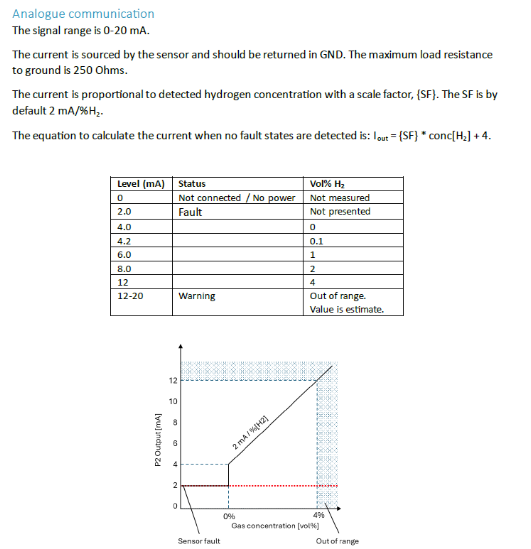
An H2 sensor which characteristics is shown below, is added to the system.
The sensor has 4-20mA output where increase of 2mA corresponds to H2 concentration increase of 1% so the scale is 2mA/1%.
The input range is set to 4-20mA which gives the current span of 20-4 = 16mA and the measuring range is set to 0-8.
The formula in B3 is:
```
y = ((x-4)*(8-0)/16)+0
```
After shortening, the formula is:
```
y = (x-4)/2
```
We may check the result for e.g. x = 8mA for which the H2 concentration shall equal 2%.
```
y = (8-4)/2 = 4/2 = 2
```
#### Example 4
A sensor with mA output is added to the system. The sensor has 4-20mA output which shall be mapped to the MP readings from -50 to +50.
The input span of 20 - 4 = 16mA shall be mapped to output span of 50 - (-50) = 100 so 1mA increase shall equal to output increase of 100/16 = 6.25. The output for x = 4 shall be -50 and for x = 20 shall be 50.
The sensor is connected to one of the channels of NWIN004 WIN 4xADC 4-20mA module.
The input range is set to 4-20mA and the measuring range to -50 to +50.
The formula in B3 is:
```
y = ((x-4)*(50+50)/16)-50
```
After shortening, the mathematical formula looks as below:
```
y = 6.25*(x-4)-50
```
We may check the result for x = 4mA for which the measurement shall be equal -50.
```
y = 6.25*(4-4)-50 = 6.25*0-50 = -50
```
The result for x = 20mA for which the measurement shall be equal 50.
```
y = 6.25*(20-4)-50 = 6.25*16-50 = 100-50 = 50
```
---
# Agent Instructions
This documentation is published with GitBook. GitBook is the documentation platform designed so that both humans and AI agents can read, navigate, and reason over technical content effectively. Learn more at gitbook.com.
## Querying This Documentation
If you need additional information that is not directly available in this page, you can query the documentation by asking a question.
Perform an HTTP GET request on the following URL with the `ask` and `goal` query parameters:
```
GET https://help.boomerang3.com/boomerang-3-domain-administrator-manual/admin/infrastructure/infrastructure__measuring_points/adc-formula.md?ask=&goal=
```
`ask` is the immediate question: it should be specific, self-contained, and written in natural language.
`goal` is what the user is ultimately trying to achieve, the reason they need the answer. Sharing it helps GitBook give you a better, more relevant answer. A goal is most helpful when it describes the outcome the user wants rather than restating the question. For example, with `ask=how do I create an API token`, a goal like `automate deployments from our CI pipeline` lets GitBook tailor the answer to that use case.
The response will contain a direct answer to the question and relevant excerpts and sources from the documentation.
Use this mechanism when the answer is not explicitly present in the current page, you need clarification or additional context, or you want to retrieve related documentation sections.